Evidence Navigation and Synthesis for Validating Interventions through Systematic, Scoping and Umbrella Reviews for ImplementatiON (ENVISSION Toolkit)
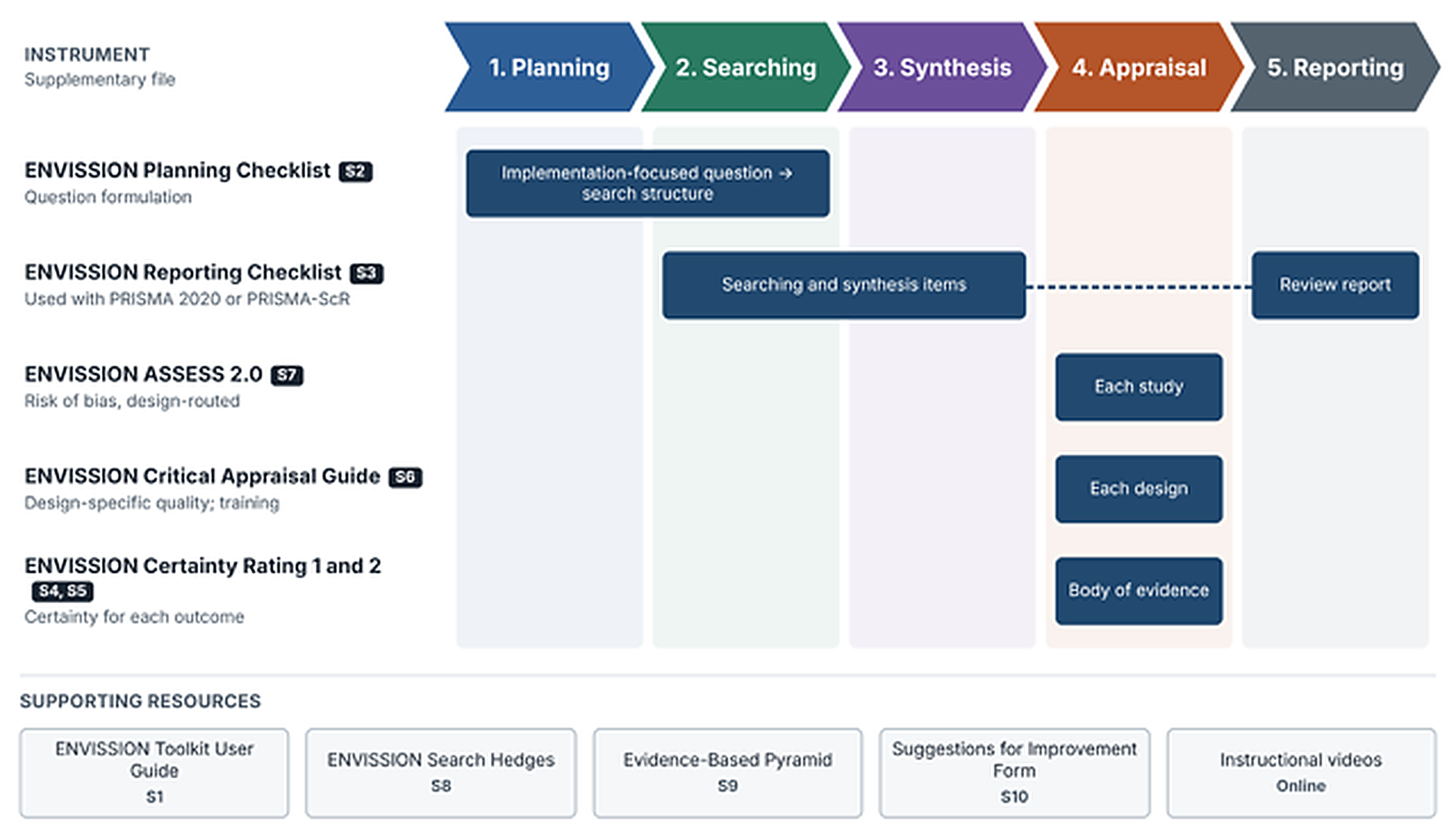
The Evidence Navigation and synthesis for Validating Interventions through Systematic and Scoping reviews for ImplementatiON (ENVISSION) Toolkit helps review teams make implementation evidence visible in systematic and scoping reviews. It provides five linked, editable instruments that carry an implementation lens from the review question to the final report, covering planning, searching, synthesis, appraisal, and reporting. The instruments are used alongside established standards such as PRISMA and GRADE, not in place of them. The toolkit was developed and tested by the Implementing Sustainable Evidence-based Interventions through Engagement (ISEE) Lab at the NYU School of Global Public Health across ten completed evidence syntheses between 2019 and 2026. All files are free to use and adapt under a CC BY 4.0 licence and come in editable and print-ready formats. New users should start with the ENVISSION Toolkit User Guide (S1).
Figure 1. The ENVISSION Toolkit at a glance
Start here: Which tool do I need?
Find your task in the left-hand column, then download the file listed. Each file number links to the file.
| If your team needs to… | Use | File |
| Understand how the toolkit fits together | ENVISSION Toolkit User Guide | S1 |
| Frame an implementation-focused question and build the search | ENVISSION Planning Checklist and ENVISSION Search Hedges | S2, S8 |
| Judge risk of bias in each included study | ENVISSION ASSESS 2.0* | S7 |
| Examine design-specific quality and transferability, or train reviewers | ENVISSION Critical Appraisal Guide | S6 |
| Grade certainty quickly for teaching or internal decisions | ENVISSION Certainty Rating 1 and Evidence-Based Pyramid | S4, S9 |
| Grade certainty for each outcome for publication | ENVISSION Certainty Rating 2 | S5 |
| Report the review | ENVISSION Reporting Checklist (with PRISMA 2020 or PRISMA-ScR) | S3 |
| Suggest an improvement | ENVISSION Toolkit Suggestions for Improvement Form | S10 |
*please email the ISEE Lab at gph.isee@nyu.edu for access to the Google form
All toolkit files (version 1.0)
Each title links to the current file on the Open Science Framework. File numbers match the supplementary files of the published article.
| File | Title | What it is for |
| S1 | ENVISSION Toolkit User Guide | How the instruments fit together and which version of each to use |
| S2 | ENVISSION Planning Checklist | An implementation-focused review question, extending PICO, that converts directly into a search structure |
| S3 | ENVISSION Reporting Checklist | Implementation-specific reporting items used alongside PRISMA 2020 or PRISMA-ScR |
| S4 | ENVISSION Certainty Rating 1 | A simplified certainty grade using the Evidence- Based Pyramid, for teaching and internal decisions |
| S5 | ENVISSION Certainty Rating 2 | A full, domain-based certainty rating for each outcome, for publication |
| S6 | ENVISSION Critical Appraisal Guide | Design-specific questions on quality and transferability; also used to train reviewers |
| S7 | ENVISSION ASSESS 2.0* (template and online form) | Design-routed risk-of-bias assessment for each included study |
| S8 | ENVISSION Search Hedges (S8a and S8b) | Pre-built search terms for low- and lower-middle-income countries (S8a) and implementation research outcomes (S8b) |
| S9 | Evidence-Based Pyramid | Locates study designs by level of evidence; used Locates study designs by level of evidence; used |
| S10 | ENVISSION Toolkit Suggestions for Improvement Form (online form) | One place to send feedback on any instrument or resource |
| S11 | ENVISSION Toolkit Development Audit Trail | How each instrument was developed, cycle by cycle |
How to Cite
Peprah E, Vieira D, Pateña J, Gandhi K, Angelo L, Hameed T, et al. The ENVISSION Toolkit: iterative development and testing of an end-to-end toolkit for implementation-focused evidence synthesis. [Journal, year, DOI].
ENVISSION Toolkit, version 1.0. Open Science Framework. 10.17605/OSF.IO/7GE9Y
ENVISSION adapts and builds on established instruments, including PRISMA, GRADE, and CASP. Please also cite the original instruments you use.
Version note