
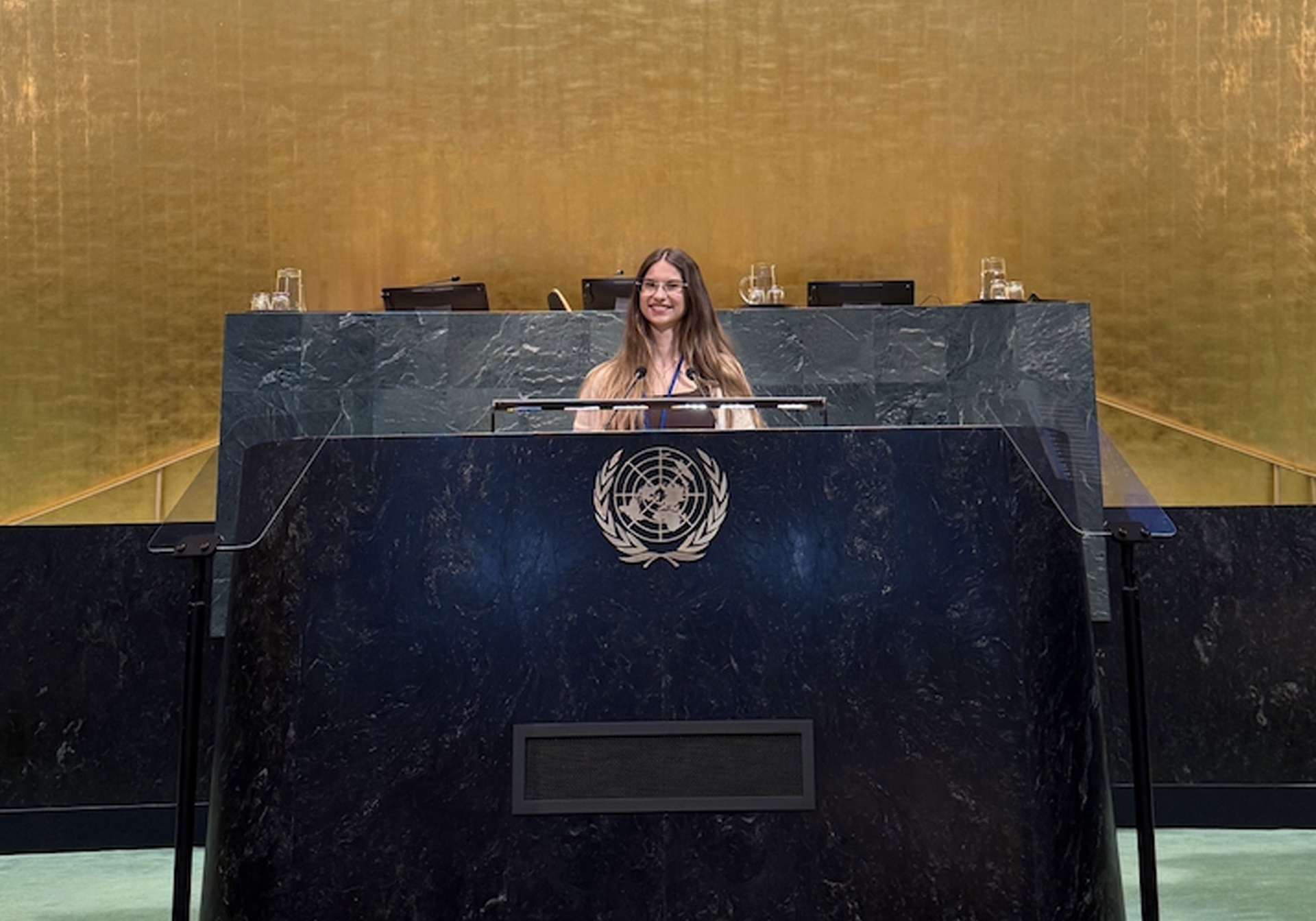
Karolína Gogoláková is unafraid to introduce herself and ask questions—well-suited to MPH studies in Health Policy and Management. In addition to her United Nations experience, Karolína is also a Research Assistant at the Safe Futures Lab, working on the prevention-focused Smart Parents Study, and she contributes to the GPH Journal of Public Health Disasters. After graduation, Karolina hopes to pursue a career in global health diplomacy and international policymaking.
Degree Program/Concentration: MPH in Public Health Policy & Management
Internship Company: Permanent Mission of the Slovak Republic to the United Nations
Internship Location: United Nations Headquarters, New York
CHOOSING THE INTERNSHIP
Why an internship at the Permanent Mission of the Slovak Republic to the UN?
My undergraduate studies in food science and nutrition first revealed to me how international cooperation and diplomacy can shape health outcomes across national borders. Since well before beginning my MPH at NYU, I’ve aspired to contribute to global health governance and evidence-based policymaking. When I arrived in New York, one of the first places I visited was the United Nations Headquarters, a moment that reaffirmed this ambition.
And my involvement with Slovak PRO, a nonprofit that facilitates networking for Slovak professionals, further shaped my path. I’ve gained insight into potential careers, cultivated professional relationships, and deepened my interest in multilateral cooperation and public service. When the opportunity arose to intern at the Permanent Mission of the Slovak Republic to the United Nations as my GPH Applied Practice Experience, it was the perfect way to bridge the study of public health with diplomacy and international affairs, and to gain direct, practical experience in the work of the UN.
THE GIG
What were your main responsibilities?
A typical week involved reviewing draft texts and summarizing key developments for colleagues, monitoring high-level negotiations on HIV/AIDS, pandemic preparedness, and universal health coverage. I attended both formal and informal UN meetings, tracked the policy positions of Member States and regional groups, and prepared briefings for colleagues in New York and Slovakia. One of my primary projects focused on the UN High-Level Meeting on Pandemic Prevention, Preparedness and Response. I helped identify Slovakia’s priorities and potential redlines, highlighting how proposed language aligned with our previous commitments. My work gave me a firsthand look into how evidence, diplomacy, and national interests come together to shape health policy.
What was your biggest learning curve?
Understanding how multilateral diplomacy works in practice was key. In class, we often focus on evidence-based solutions and what the “best” public health policy might be. At the UN, I learned that policymaking requires balancing scientific evidence along with political priorities, national interests, and the perspectives of nearly 200 Member States.
Did you gain any new skills?
I learned how to navigate the fast-paced nature of UN negotiations. Draft texts changed daily and positions evolved rapidly. Analyzing draft resolutions and political declarations strengthened my ability to identify politically sensitive issues, consider their implications for Slovakia, and communicate complex developments clearly to support decision-making. This experience strengthened my ability to think strategically, work under pressure, and adapt quickly in a dynamic international environment.
HIGHLIGHTS AND REFLECTIONS
What's been an unexpected part of your internship?
One of the most surprising aspects was seeing the human side of diplomacy. Because discussions often focus on complex global health issues with significant political implications, I imagined UN negotiations to be very formal and serious at all times. But I discovered that delegates could also be personable, humorous, and genuinely enjoy interacting with one another. Even during long negotiations, there were moments of laughter and lighthearted conversation that helped build relationships across delegations.
It was also revealing to witness how carefully every word in a resolution or political declaration is considered. A single phrase can represent hours of discussion among Member States, many with competing priorities and perspectives. Observing this process gave me a much deeper appreciation for the complexity of global health governance, and the challenges of reaching consensus among countries.
THE SOCIAL AND CULTURAL EXPERIENCE
How did you connect with other people?
Although I was the only intern at the Permanent Mission, I quickly felt like part of the team. My colleagues were very welcoming, and took the time to answer my questions and involve me in meaningful work. Early on, I met with each colleague to learn about their portfolio, the UN committees they cover, and their role at the Mission. I also had the opportunity to interact with diplomats from other Permanent Missions, the European Union, and UN agencies during negotiations, coordination meetings, high-level events, and diplomatic receptions.
Any memorable moments?
I’m proud of the level of responsibility I was entrusted with throughout my internship. I was trusted to track rapidly changing negotiations, flag key developments, and communicate the information needed to support Slovakia’s engagement in multilateral processes. In addition, I contributed to the Mission’s diplomatic outreach to other Permanent Missions, and drafted official correspondence letters that were circulated to UN delegations as part of preparations for negotiations. Being trusted with both substantive policy work and diplomatic communication gave me confidence that my contributions were valued. I’m incredibly grateful to the Permanent Mission of Slovakia and to GPH for this rewarding experience. It allowed me to collaborate with diplomats and public health professionals in a multicultural environment, strengthened my skills and confidence, and encouraged my pursuit of a career in global health diplomacy and international policymaking.
ADVICE FOR CLASSMATES
What would you tell other students?
Be proactive and take advantage of every networking opportunity. I would also encourage students not to underestimate the value of the skills they develop during their MPH. Strong research, writing, and policy analysis skills are highly transferable, and organizations like the UN value students who can think critically and communicate complex information clearly. Be curious, ask questions, and don’t be intimidated; everyone starts somewhere, and showing initiative can open unexpected doors. I’m incredibly grateful to the Permanent Mission of Slovakia and to GPH for this rewarding experience. It allowed me to collaborate with diplomats and public health professionals in a multicultural environment, strengthened my skills and confidence, and encouraged my pursuit of a career in global health diplomacy and international policymaking.