
No stranger to research, Kayla Bliven received her BS in Insect Biology from Purdue University before enrolling in the MS in Epidemiology program at NYU GPH. While she hopes to publish some of her research soon, she’s also become involved in community outreach events, even working as an America Reads tutor. After graduation, Kayla aims to pursue a PhD and continue vector-borne disease research, though she may potentially work in vaccine development before pursuing her doctorate.
Degree Program: MS in Epidemiology
Internship Company: Wadsworth Center, New York State Department of Health
Internship Location: Albany, NY
CHOOSING THE INTERNSHIP
What was your APE, and how did you find it?
My internship was at the Wadsworth Center, which is a public health laboratory for the New York State Department of Health. I've always been interested in infectious disease epidemiology and vector-borne disease; my undergrad degree was in insect biology. When I enrolled at NYU GPH I’d see good places to work after graduation, and read about people who had similar interests. So I’d independently reach out and ask questions, not really expecting much, just wanting information.
One of those conversations was with Dr. Alex Ciota at the Wadsworth Center, who offered me an opportunity with researchers investigating questions that closely aligned with the focus of my studies in public health and molecular biology. And my conversations with GPH faculty member Brian Spitzer were also incredibly supportive. He reviewed the project proposal that I created and helped me refine the direction I wanted to pursue in my deliverable. Alongside that, my coursework reinforced my understanding of how epidemiology and disease intersect, so that was a solid foundation for my APE work at the Wadsworth Center.
THE GIG
What were your responsibilities, and what was your day like?
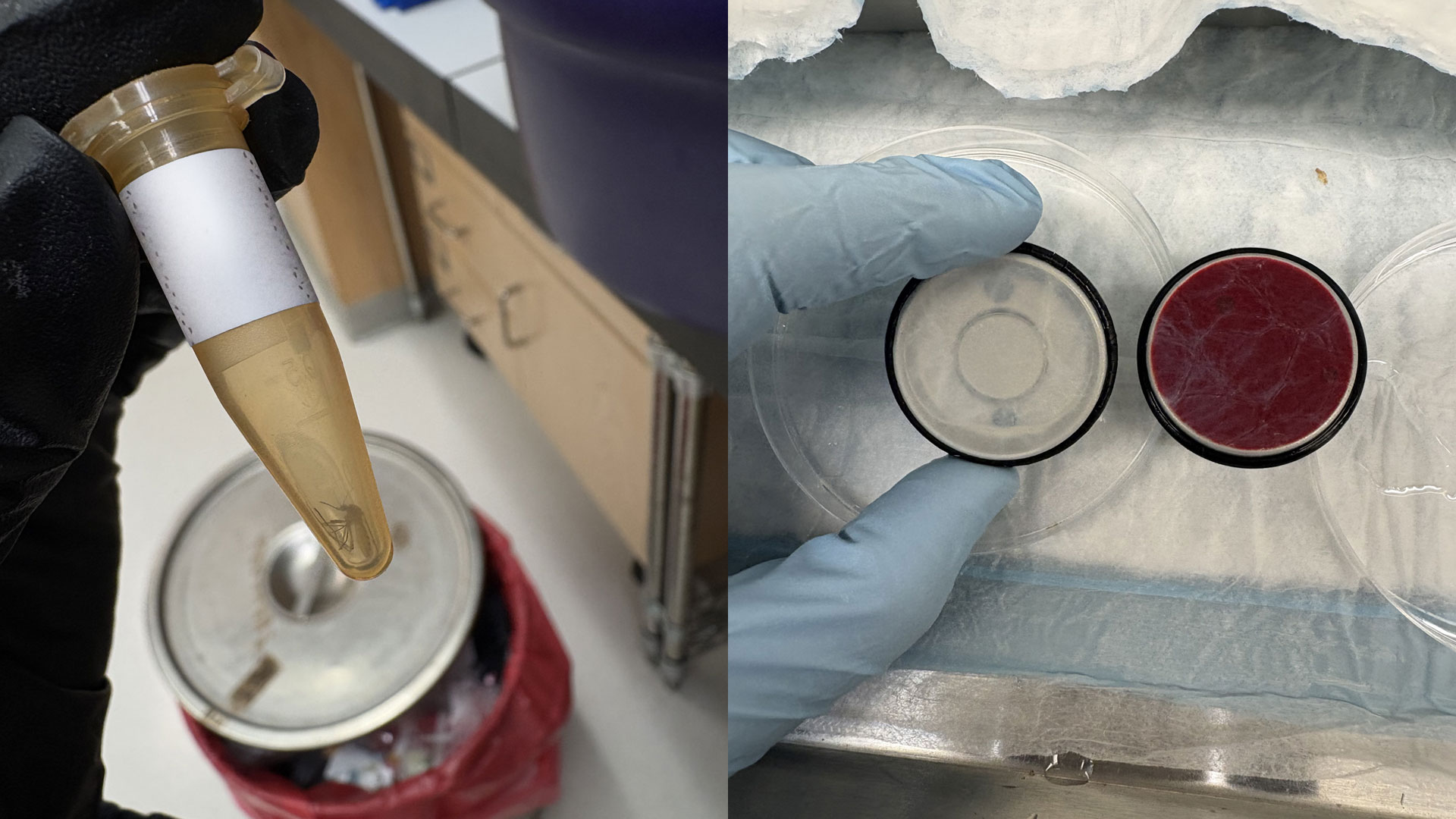
The best part of this internship is that they let me independently conduct my own research; it was part of a large grant, but the work was my own that I created with my mentor. I’ve actually run independent research before, but that was a project I took over. This time around I asked the question, refined the study design, and executed it by carrying out the experiment and creating the data. It was exciting, real-world public health from design to execution to analysis. I was studying how cold temperatures can influence mosquito physiology and their transmission of arboviruses, to get a better sense of how seasonal environments affect the risk of mosquito-borne disease. A lot of it was molecular biology, so first I did a whole lot of RNA extractions and running RTQPCR tests, then I looked at RNA to see how it's expressed within my mosquitoes.
Wednesday was mosquito maintenance day. There were big tubs full of mosquito pupae; we had blood meals to feed them, and then you had to catch them with a pipette and move them to a different container. They moved really fast, so when you got down to the last few, it could be frustrating. There were over 300 mosquitoes—that’s a lot! But I've been doing this since undergrad; it was kind of therapeutic for me, kind of relaxing. I know that sounds weird, but it’s like a video game: Pick the pupae up, move them here.
In addition to my classwork and another job to support myself, I worked in the lab two or three days a week, leaving my apartment at 4:00 am, and commuting on the bus to Albany. Then I’d do as much work at the Wadsworth Center as possible, so typically I didn’t eat until I got on the bus again, getting home around 10:00 pm. When I explain it to most people they think it sounds miserable, but working there was fun, and I loved it.
HIGHLIGHTS AND REFLECTIONS
What was your favorite part of the experience?
What really stood out to me was the willingness of scientists to answer my questions and teach me. They want you to learn; they want to help you grow as a scientist. So that was really reassuring as I consider my professional path. Also, that research lab within the state department of health was large, and my mentor encouraged me to talk to other researchers, even if it wasn't connected to my work. It was neat to see what people are doing, how they write grants, and all the effort that goes into that—but also the passion behind it. The cool thing about working in a large lab is that you get to see a lot.
I also think beyond the technical skills, I’ve gained a greater appreciation for the planning that goes into scientific research, and what goes into smaller decisions that impact the quality of a study. When you're reading a study, you don't always see the details. Once you design a study and start carrying it out, you make connections and can better understand why doing something is important.
THE SOCIAL AND CULTURAL EXPERIENCE
How did you connect with other people?
The postdoctoral researcher who I worked with closely was my APE mentor; we also had nice regular conversations, and it was the same with my peers. Say you had a tight deadline for data collection; people would stop by randomly to help out, you’d sit together and end up chatting, not always about work. We tended to have similar outside interests, so I connected with them that way. And I was the youngest person there, so that offered valuable perspective, too.
ADVICE FOR CLASSMATES
Is there anything else you’d like to share about your experience?
Don't be afraid to reach out to people whose work interests you. Every conversation is an opportunity, even if it doesn't immediately lead to a position; in the worst case scenario, you have learned something new. You never know; I was offered an internship just in the course of asking questions. I've also learned that feeling like you're the least experienced person in the room isn't something to avoid, it's often a sign that you're in exactly the right place to grow. It was hard for me, though, to learn that feeling like the dumbest person in the room means you have the most to gain by being there. It's an uncomfortable feeling, but it’s worth it in the long run as you continue to grow. I've learned so much from this internship, including tolerating being uncomfortable as an opportunity to grow.
How has your internship shaped your goals? Has your "dream career" changed?
I was always back and forth about what I wanted to do, but this experience has inspired me to consider pursuing a PhD after completing my master's degree. With the encouragement I received during my internship, a PhD has become something that feels like a good fit. I’m passionate about my work, and you need to be passionate about your work to get a PhD. Long-term, my APE reinforced my focus on vector-borne disease transmission, and building a public health research career that integrates both molecular biology and epidemiology.