
This summer, a multidisciplinary team of NYU students and Dr. Nina Parikh, Clinical Associate Professor of Social and Behavioral Sciences, conducted a randomized pilot study to explore whether immersive virtual reality (VR) versus non-immersive (laptop) viewing of travel videos can support psychological well-being in older adults.
The research team partnered with India Home, a New York City community-based organization serving South Asian older adults, to evaluate whether delivering VR experiences in a community setting is feasible and acceptable, and to assess short-term changes in self-reported mood and well-being.
“Virtual reality has growing potential for older adults because it can offer engaging, enjoyable experiences in a controlled setting and may be accessible even for individuals with mobility limitations or fewer opportunities for leisure and social participation,” said Dr. Parikh.
For the student researchers involved, the fieldwork provided a bridge between academic study and real-world impact.
Yifan Shi, a PhD student in Social and Behavioral Sciences, contributed to the study design, IRB preparation, and recruitment. “I’m interested in how loneliness and social interaction shape health in the aging process,” Yifan shared. “This experience has strengthened my commitment to developing community-based interventions for older adults.”
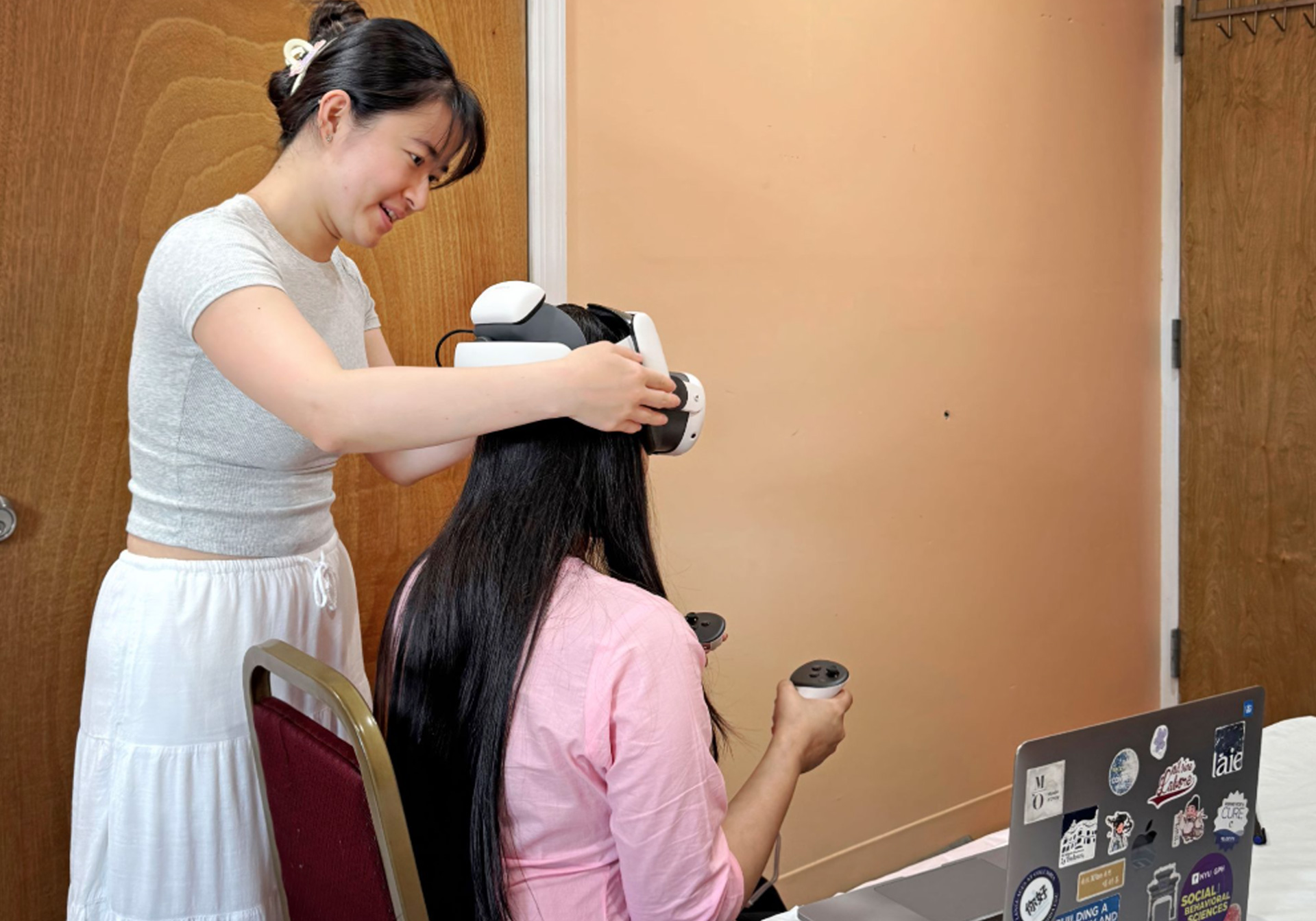
Deshna Jain, an MS in Computer Science student at NYU Courant, handled participant scheduling, communication, and on-site data collection for the VR sessions. “This project let me combine my technical background with public health impact, making it a natural fit for my interests in applied AI/VR,” said Deshna. “The experience has deepened my interest in working at the intersection of AI/tech and public health, rather than pure software engineering.”
Preliminary results from 86 participants showed that short-term mood improved following scenic video viewing in both groups, with no evidence of additional immediate mood benefit from immersive VR versus non-immersive laptop viewing. These findings can inform larger studies evaluating VR-based well-being interventions in culturally diverse older adult populations.