
Jade Killikenny was no public health novice when she signed up for NYU’s study abroad course A Systems Approach to Climate Change. With an undergraduate degree in public health, prior fieldwork in Uganda, and a keen interest in strategies that meet communities where they are, Jade was eager to join a pitch competition against a dozen other teams to propose and build solutions to climate change problems in Tanzania. Ready to forge ahead and prescribe interventions, Jade wrote, “What the course actually taught me was to slow down and listen before reaching for a solution at all.”
You might expect a graduate school with “global” in its name to offer innovative courses around the world. But the GPH guiding principle to “Go Far” involves more than geographic boundaries; it also motivates its stellar faculty to expand fieldwork experiences beyond what a classroom can provide. This singular course, led by Dr. Chris Dickey and faculty colleagues from NYU Steinhardt and NYU SPS, teaches new ways to optimize outcomes by treating grassroots communities and government systems as partners in co-designing solutions, rather than as beneficiaries of top-down, traditional siloed interventions.
Taught in partnership with UNICEF Tanzania and the State University of Zanzibar (SUZA), the culminating event was a competition among multi-disciplinary teams comprising students, government officials, local NGO personnel and community members. The goal was to push the public health envelope in addressing socio-ecological threats that face the Zanzibar archipelago. The final presentations were evaluated by an esteemed panel including Dr. Laxmi Bhawani, Chief of UNICEF, Zanzibar; Dr. Said Khamis Juma, Deputy Vice-Chancellor of SUZA; Dr. Mary Mtumwa Khatib: Senior Lecturer and head of an environmental research center at SUZA; and the Honorable Dr. Khamis Said, Permanent Secretary of the Ministry of Education, Revolutionary Government of Zanzibar.
The winning proposal on riverbank restoration was lauded by the judges for its immediate stabilization benefits, ecological alignment and intense community participation. As a member of the winning team, Jade acknowledged their success was hard-won. For instance, the team suggested early warning systems, until community members explained that warnings were useless when flooding is inevitable. When the team proposed wire mesh and stone walls seen in literature, the community knew that only cement would last in their conditions. Even planting choices were driven by the use of species already cultivated locally at no procurement cost.
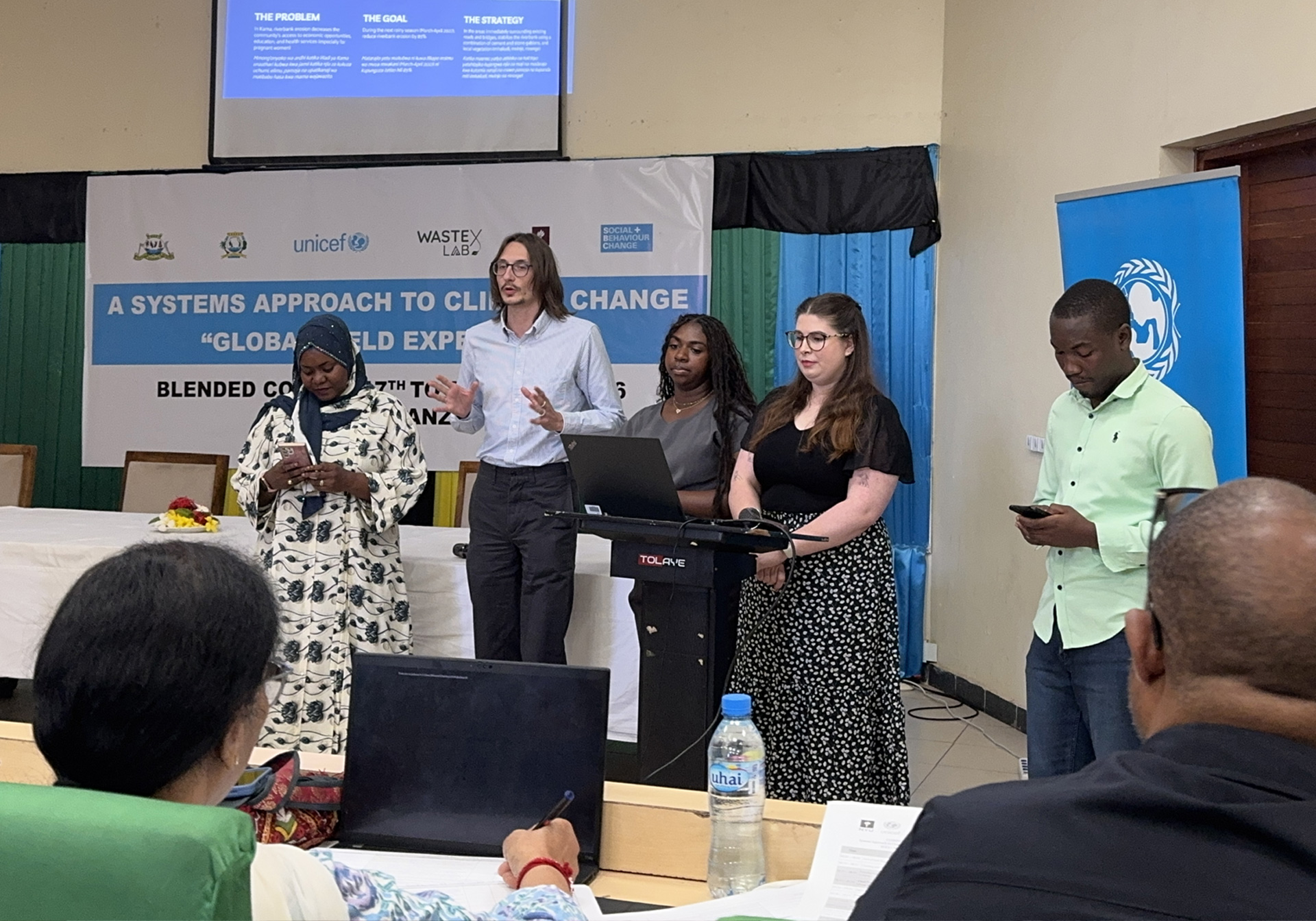
Reflecting on the course, Jade, who is concentrating her MPH studies in Global Health, said she gained “a different definition of expertise. I arrived believing that my job was to bring solutions; I left realizing that my job is to build the conditions under which a community’s own solutions become fundable, durable and visible to institutions. I loved my team; the friction between our perspectives on government, technology and international relations made the proposal better at nearly every step. My training pushed me toward behavior change and monitoring, but my teammates pushed back with questions about governance, budgets, and political feasibility that I would not have asked on my own. I also loved the setting itself, not as a backdrop but as a teacher.”
Jade’s NYU Wagner teammate, Jammes Crowther, recalled, “The residents needed help with their bridges (or lack thereof) and access to reliable school and medical services. The challenge was that, logically, the large-scale infrastructure investments needed were not an option, so we had to find something feasible and effective in addressing their concern. Our faculty had urged us to consider the community’s input over our own desires and interests, and it was in this balancing act that my team’s problem-solving skills shone. We identified several strategies, did extensive research and had many honest conversations, deciding together the best approach. Before this trip I lacked direct, on-the-ground development skills that you learn outside of the classroom. This course gave me that fieldwork experience, and it was an honor to win the competition. But most of all, I’m so glad that the community is going to be improved, and we were a part of the plan coming to fruition.”
As dual degree student (MPA/MPH) Abby Brachio recalls it, “Our teamwork was intentional, and we quickly integrated regardless of affiliation, each of us with unique strengths. Asha brought local knowledge, Badru helped break down the language barrier, Jammes was always playing “devil’s advocate” in a way that helped strengthen our ideas, and Jade ensured we were focused on the right goal (near term, meaningful impact for the community). I contributed organization and leadership. Elements of our proposal are clearly attributable to each member, and I love that they could be integrated in such a remarkable way. Academically and in terms of ethos, I respected Profs. Carol Anne Spreen from NYU Steinhardt and Olajumoke Ayandele from NYU SPS, in how they approach international development and community engagement. Based on their lectures and example, I’m prompted to consider how I present myself, especially when working with vulnerable populations. We talked a lot about reciprocity, and I gained “soft skills” and ways of thinking that I will carry with me into my career.”