
Over the course of her education, Sarah Sebton grew to understand how trauma from the past can inform behavior in the future, and she found herself drawn to trauma-informed healthcare, working to create safe and supportive environments where both patients and staff are empowered to take part in their own wellbeing.
So it was a perfect fit when Sarah accepted a position directing trauma-informed care (TIC) at University Health in San Antonio, TX in January, 2020. In that role, she explains, “I train healthcare staff to recognize the signs and symptoms of trauma, and how to collaborate with and empower people who have experienced trauma, to start their journey toward healing.” She summarized it by saying, “I shift the conversation from ‘What's wrong with you?’ to ‘What happened to you?’”
After earning a BS in Health & Exercise Science in 2013 from Wake Forest University, Sarah wanted to gain professional experience before pursuing another degree, so she spent a year as a presidential fellow in health administration at a hospital. A mentor of hers from Wake Forest, Dr. Rogan Kersh, who had worked previously at NYU and is now associate vice chancellor for global programs there, suggested she look into its master’s degrees; she ultimately enrolled in a dual-degree program where she earned a Master of Public Health at NYU GPH concurrently with a Master of Public Administration at NYU Wagner.
Sarah made the most of her time at NYU, and over the course of her studies her interests became clear. “As a student I realized that my passion was really the social determinants of health; that's how trauma-informed care makes sense to me,” Sarah said. “It’s thinking about what we've been through in our own life experience and how that impacts our health and wellbeing.”
One thing is sure: Being in the Big Apple turbo-charged Sarah’s academic path. “Going to school in New York City allowed me to work at some incredible organizations headquartered there. While I was a student, I worked part-time for both Smile Train and the Mount Sinai health system, and having these nationally-recognized organizations on my resume definitely helped kickstart my career,” Sarah said. “Not to mention the great work experience that I gained in the nonprofit sector and also at a health system; with the connections I made in both places I definitely appreciated being in the city and having those great opportunities.”
Within weeks of beginning her current position, the Covid-19 virus swept around the globe, but Sarah had the public health tools she needed. “The most rewarding part of my job is providing wellness and resilience programming to our hardworking healthcare staff,” she said. In the midst of a global pandemic she witnessed health care workers working tirelessly in the face of fear and uncertainty, and in response she provided self-care opportunities for workers by creating “recharge rooms,” which are quiet, private spaces for staff to decompress, encouraging resilience. She also brought Schwartz Rounds to the health system, creating opportunities for staff to talk about the social and emotional aspects of working in healthcare, encouraging connection and belonging.
Sarah said, “It was really meaningful to be an innovator in TIC during such a difficult time, and my motivation was the frontline workers at my hospital who somehow found ways to laugh and smile and support one another. They can provide better patient care when I can provide them with the support that they need.”
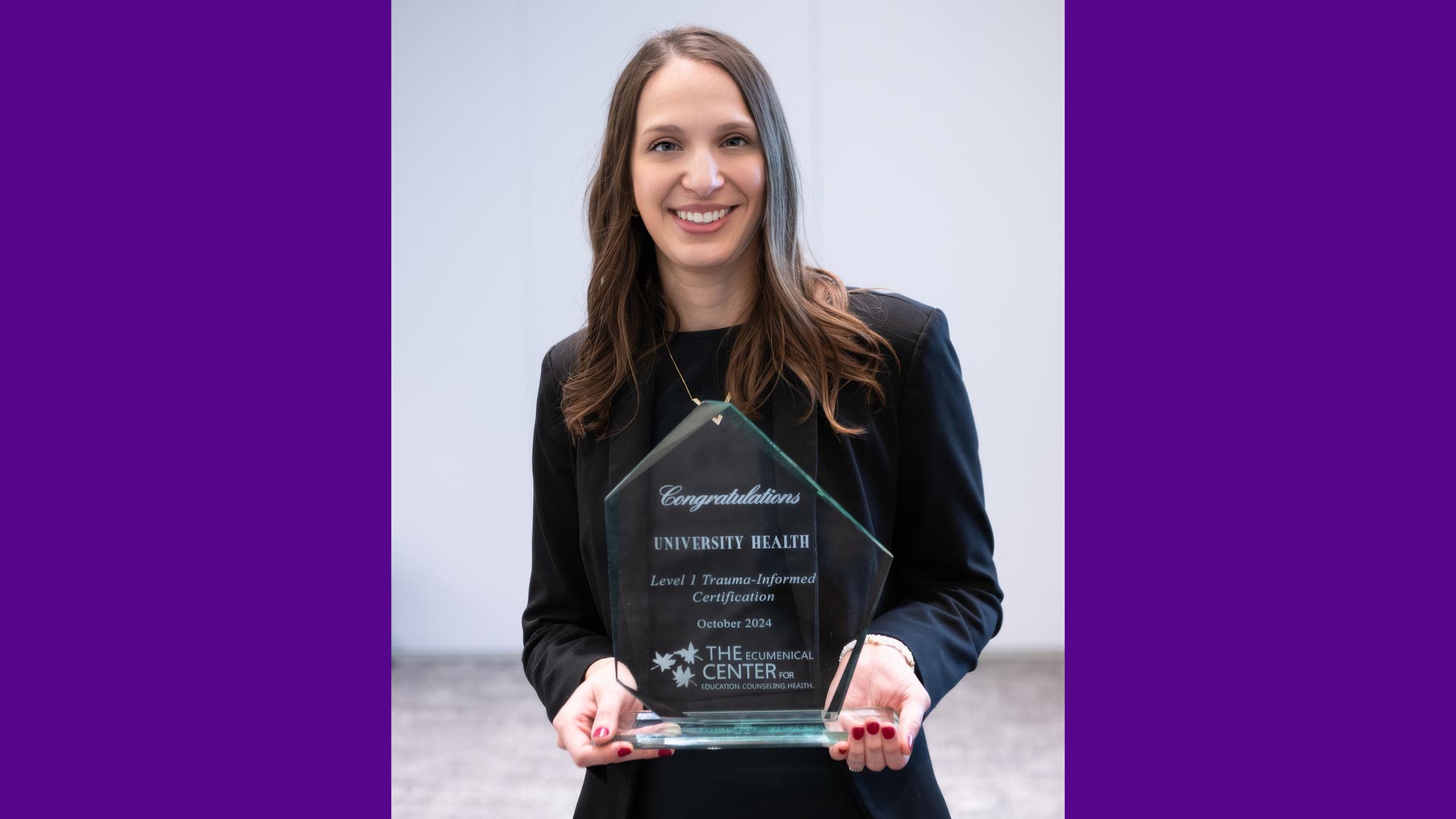
Since then, Sarah has led University Health to become the first health system in the nation to receive a formal designation in trauma-informed care, and she was named one of the San Antonio Business Journal’s “40 Under 40” for her work. She’s also been promoted to Executive Director, Behavioral Health and Trauma-Informed Care, taking on the operational and administrative functions of the service line in addition to sustaining the organization’s TIC efforts.
“What drove me to this field was truly acknowledging my own adverse childhood experiences and my own adult traumas, but also realizing that I had some amazing people in my life—mentors and friends, and even professors at NYU—who lifted me up and pointed me in the right direction. I came to understand that what we've been through in our life impacts our future, but it doesn’t have to be our destiny.”