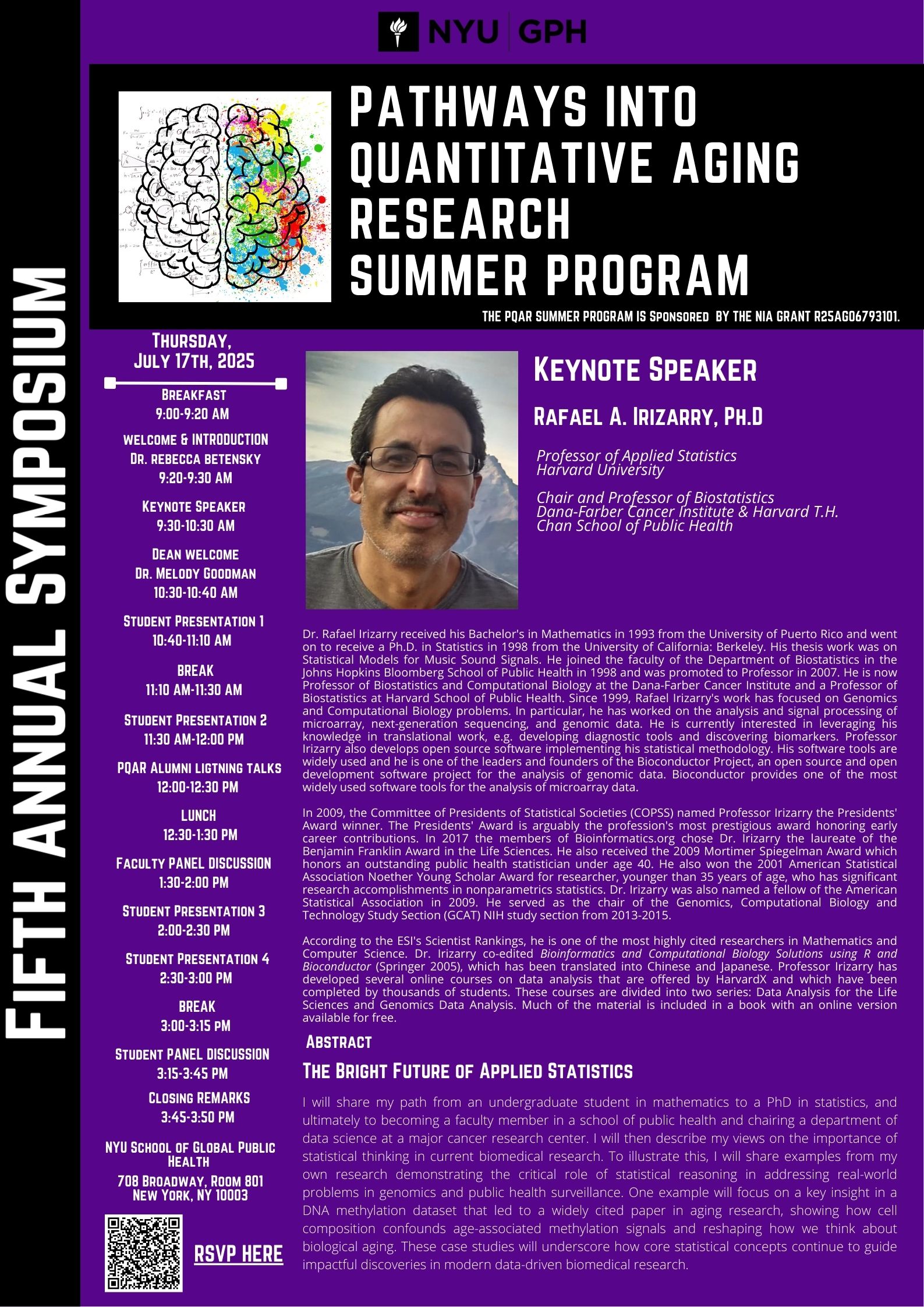
NYU School of Global Public Health I Fifth Annual Symposium
Pathways into Quantitative Aging Research Summer Program
The PQAR Summer Program is sponsored by the NIA grant R25AG06793101
Date: Thursday, July 17, 2025
Program Schedule:
9:00 AM: Breakfast
9:20 AM: Welcome & Introduction
9:30 AM: Keynote Speech: Dr. Rafael A. Irizarry
10:30 AM: Dean Welcome
10:40 AM: Student Presentations 1
11:30 AM: Student Presentations 2
12:00 PM: Lightning Talks
12:30: Lunch
1:30 PM: Faculty Panel Discussion
2:00 PM: Student Presentations 3
2:30 PM: Student Presentations 4
3:15 PM: PQAR Alumni Panel
NYU School of Global Public Health (708 Broadway New York, NY 10003)
Meet our 2025 PQAR Cohort HERE
Read about the Research Projects HERE
Keynote speaker: Rafael A. Irizarry, Ph.D, Professor of Applied Statistics, Harvard University; Chair and Professor of Biostatistics, Dana-Farber Cancer Institute & Harvard T.H. Chan School of Public Health
Dr. Rafael Irizarry received his Bachelor's in Mathematics in 1993 from the University of Puerto Rico and went on to receive a Ph.D. in Statistics in 1998 from the University of California: Berkeley. His thesis work was on Statistical Models for Music Sound Signals. He joined the faculty of the Department of Biostatistics in the Johns Hopkins Bloomberg School of Public Health in 1998 and was promoted to Professor in 2007. He is now Professor of Biostatistics and Computational Biology at the Dana-Farber Cancer Institute and a Professor of Biostatistics at Harvard School of Public Health. Since 1999, Rafael Irizarry's work has focused on Genomics and Computational Biology problems. In particular, he has worked on the analysis and signal processing of microarray, next-generation sequencing, and genomic data. He is currently interested in leveraging his knowledge in translational work, e.g. developing diagnostic tools and discovering biomarkers. Professor Irizarry also develops open source software implementing his statistical methodology. His software tools are widely used and he is one of the leaders and founders of the Bioconductor Project, an open source and open development software project for the analysis of genomic data. Bioconductor provides one of the most widely used software tools for the analysis of microarray data.
In 2009, the Committee of Presidents of Statistical Societies (COPSS) named Professor Irizarry the Presidents' Award winner. The Presidents' Award is arguably the profession's most prestigious award honoring early career contributions. In 2017 the members of Bioinformatics.org chose Dr. Irizarry the laureate of the Benjamin Franklin Award in the Life Sciences. He also received the 2009 Mortimer Spiegelman Award which honors an outstanding public health statistician under age 40. He also won the 2001 American Statistical Association Noether Young Scholar Award for researcher, younger than 35 years of age, who has significant research accomplishments in nonparametrics statistics. Dr. Irizarry was also named a fellow of the American Statistical Association in 2009. He served as the chair of the Genomics, Computational Biology and Technology Study Section (GCAT) NIH study section from 2013-2015.
According to the ESI's Scientist Rankings, he is one of the most highly cited researchers in Mathematics and Computer Science. Dr. Irizarry co-edited Bioinformatics and Computational Biology Solutions using R and Bioconductor (Springer 2005), which has been translated into Chinese and Japanese. Professor Irizarry has developed several online courses on data analysis that are offered by HarvardX and which have been completed by thousands of students. These courses are divided into two series: Data Analysis for the Life Sciences and Genomics Data Analysis. Much of the material is included in a book with an online version available for free.
Abstract
The Bright Future of Applied Statistics
I will share my path from an undergraduate student in mathematics to a PhD in statistics, and ultimately to becoming a faculty member in a school of public health and chairing a department of data science at a major cancer research center. I will then describe my views on the importance of statistical thinking in current biomedical research. To illustrate this, I will share examples from my own research demonstrating the critical role of statistical reasoning in addressing real-world problems in genomics and public health surveillance. One example will focus on a key insight in a DNA methylation dataset that led to a widely cited paper in aging research, showing how cell composition confounds age-associated methylation signals and reshaping how we think about biological aging. These case studies will underscore how core statistical concepts continue to guide impactful discoveries in modern data-driven biomedical research.