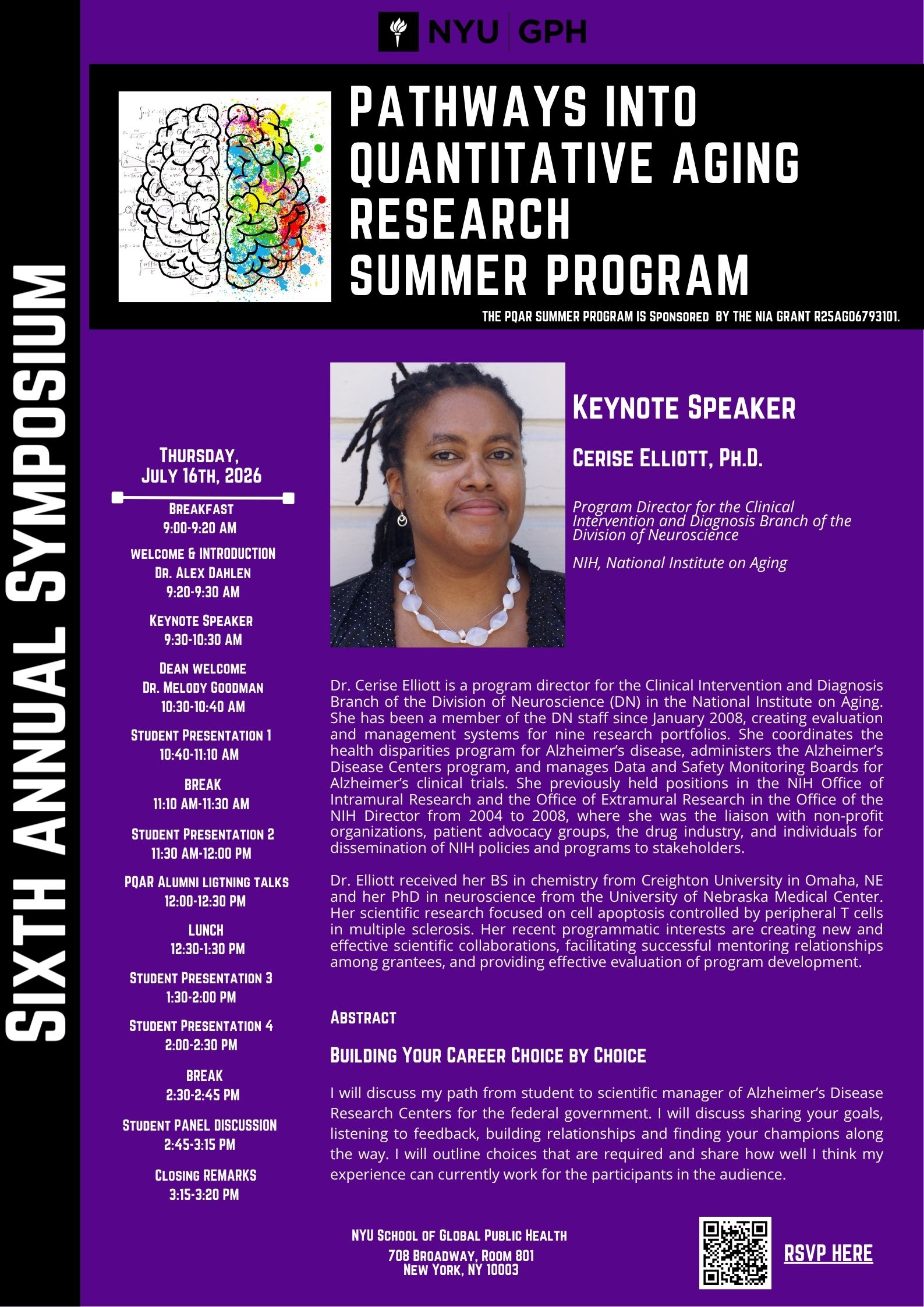
NYU School of Global Public Health I Fifth Annual Symposium
Pathways into Quantitative Aging Research Summer Program
The PQAR Summer Program is sponsored by the NIA grant R25AG06793101
Date: Thursday, July 16, 2026
Program Schedule:
9:00 AM: Breakfast
9:20 AM: Welcome & Introduction: dr. Alex Dahlen
9:30 AM: Keynote Speech: Dr. Cerise Elliott
10:30 AM: Dean Welcome
10:40 AM: Student Presentations 1
11:30 AM: Student Presentations 2
12:00 PM: Lightning Talks
12:30: Lunch
1:30 PM: Student Presentations 3
2:00 PM: Student Presentations 4
2:45 PM: PQAR Alumni Panel
NYU School of Global Public Health (708 Broadway New York, NY 10003)
Meet our 2026 PQAR Cohort HERE
Read about the Research Projects HERE
Keynote speaker: Cerise Elliott, Ph.D. Program Director for the Clinical Intervention and Diagnosis Branch of the Division of Neuroscience NIH, National Institute on Aging
Dr. Cerise Elliott is a program director for the Clinical Intervention and Diagnosis Branch of the Division of Neuroscience (DN) in the National Institute on Aging. She has been a member of the DN staff since January 2008, creating evaluation and management systems for nine research portfolios. She coordinates the health disparities program for Alzheimer’s disease, administers the Alzheimer’s Disease Centers program, and manages Data and Safety Monitoring Boards for Alzheimer’s clinical trials. She previously held positions in the NIH Office of Intramural Research and the Office of Extramural Research in the Office of the NIH Director from 2004 to 2008, where she was the liaison with non-profit organizations, patient advocacy groups, the drug industry, and individuals for dissemination of NIH policies and programs to stakeholders.
Dr. Elliott received her BS in chemistry from Creighton University in Omaha, NE and her PhD in neuroscience from the University of Nebraska Medical Center. Her scientific research focused on cell apoptosis controlled by peripheral T cells in multiple sclerosis. Her recent programmatic interests are creating new and effective scientific collaborations, facilitating successful mentoring relationships among grantees, and providing effective evaluation of program development.
Abstract
Building Your Career Choice by Choice
I will discuss my path from student to scientific manager of Alzheimer’s Disease Research Centers for the federal government. I will discuss sharing your goals, listening to feedback, building relationships and finding your champions along the way. I will outline choices that are required and share how well I think my experience can currently work for the participants in the audience.